
The History of the Empire State Building: New York’s King of the Skyline
The Chrysler Building wore the crown for eleven months. The Empire State Building wore it for nearly forty years. Raised in just 410 days at the depth of the Great Depression, it shot past its Midtown rival to become the tallest structure on Earth — and then refused to give the title back. Nearly a century later, it is still the silhouette the whole world pictures when it imagines New York. Its story is one of speed, a high-stakes rivalry, and a tower built on sheer nerve when the country had every reason to stop building.
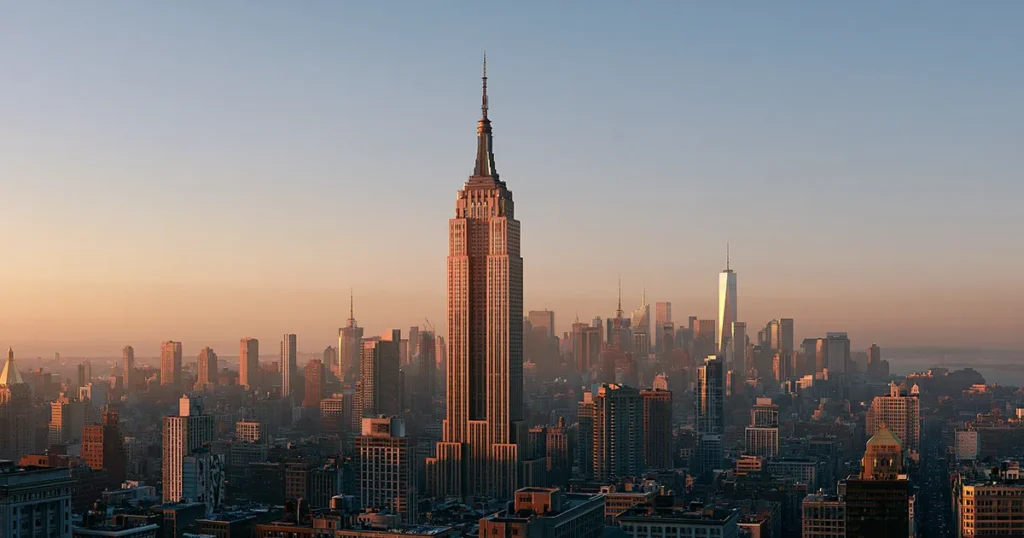
The Empire State Building’s limestone tower and Art Deco mast above Midtown Manhattan.
A Skyscraper Born of a Rivalry
The building was the work of John J. Raskob, the financier behind General Motors, who wanted to out-build Walter Chrysler — the automobile man who had just topped the New York skyline. Raskob assembled a syndicate of investors, brought in former New York governor Al Smith as the project’s public face, and set out to raise the tallest building in the world on the site of the original Waldorf-Astoria Hotel.
The story most often told captures the spirit of the thing perfectly. Raskob is said to have held up a thick pencil and asked his architect, William Lamb, “How high can you make it so that it won’t fall down?” Lamb, of the firm Shreve, Lamb and Harmon, answered with a design of ruthless efficiency — a tower engineered to rise fast and economically, every floor stacked cleanly toward the sky.
The Race Against the Clock
Where the Chrysler Building won on artistry, the Empire State Building won on sheer speed. Ground broke in March 1930, and the steel frame climbed at a pace that stunned the city — more than four floors a week at its peak, with thousands of workers swarming the rising skeleton. From the first column to the finished tower, the building took just 410 days.
The secret weapon in the height race sat at the very top. Officially, the slender mast crowning the building was a mooring station for dirigibles — the idea being that passengers would step off an airship a quarter mile in the air and ride an elevator down to the street in minutes. In truth, the mast also pushed the building’s height beyond anything its rivals could reach.
When it opened on May 1, 1931, the Empire State Building stood 1,250 feet tall — past the Chrysler Building, past 40 Wall Street, the tallest structure in the world. And unlike Chrysler’s fleeting eleven-month reign, this title would hold. The Empire State Building would remain the tallest building on Earth for nearly forty years.
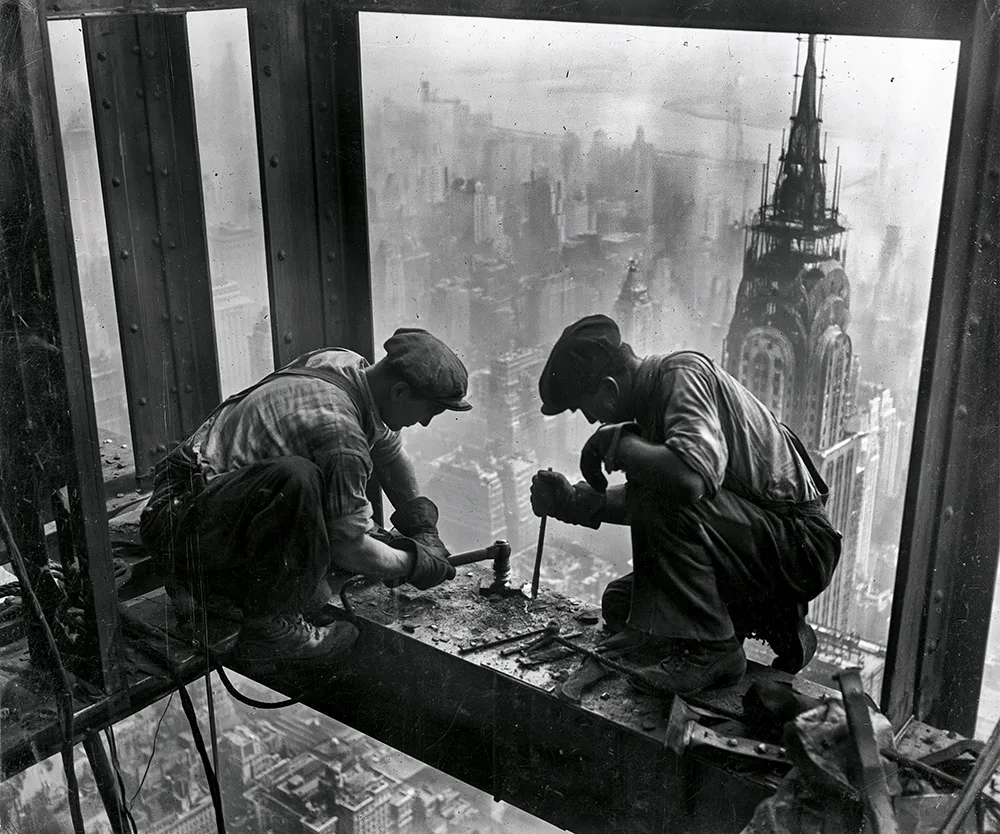
Steelworkers raising the Empire State Building’s frame in 1930 — more than four floors a week at its peak.
The airship dream never panned out. Updrafts swirling around the tower made docking lethally dangerous, and after a couple of white-knuckle attempts in 1931 the idea was quietly abandoned. The mast found a second life instead — first as an observation perch, and later as the base for the broadcast antenna that still crowns the building today.
An Art Deco Landmark
For all its speed, the Empire State Building was no plain box. Lamb clad the tower in Indiana limestone and granite, with shimmering vertical bands of aluminum and stainless steel running up its face. A series of setbacks steps the building inward as it climbs, drawing the eye toward that famous tapering crown — restrained, elegant, and unmistakably Art Deco.
Inside, the lobby is a Machine Age jewel: a soaring marble hall centered on a gleaming aluminum relief of the building itself, set against radiating golden sun rays. It was a deliberate statement. This was not merely a place to work, but a monument to what modern American industry could raise.
If that streamlined geometry speaks to you, the Empire State Building blueprint print captures the tower as a vintage technical drawing, drafting lines and all. For a moodier take on the city it crowns, the black-and-white New York City print sets the skyscraper against a rain-slicked Manhattan street scene.
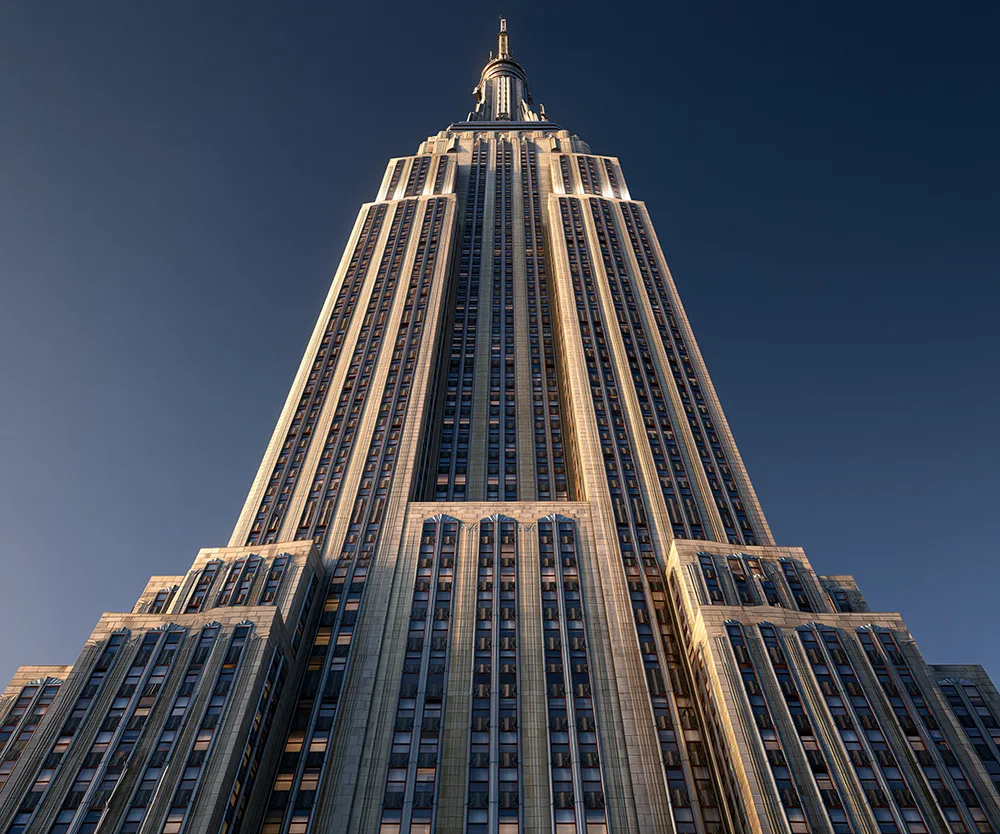
The Empire State Building’s stepped setbacks and tapering Art Deco crown.
Inside the Icon
From the start, the view was the building’s greatest asset. Observation decks on the 86th and 102nd floors offered visitors a vantage over Manhattan that no one had ever had before — and in the lean early years, the tickets those tourists bought helped keep the building afloat. The three-story lobby, the marble corridors, and the elevators that rocketed passengers skyward were all part of the spectacle.
The Empire State Building After Dark
Here is something most people never realize: the glowing, color-changing tower we know today was not part of the original plan. For decades the building stood dark against the night sky. Floodlights to illuminate the top were not added until 1964, and the now-famous colored lights did not arrive until 1976, when the tower first glowed red, white, and blue for the nation’s bicentennial.
That after-dark magic is exactly what the Empire State Building night cityscape print captures, the tower glowing against a deep Manhattan sky.
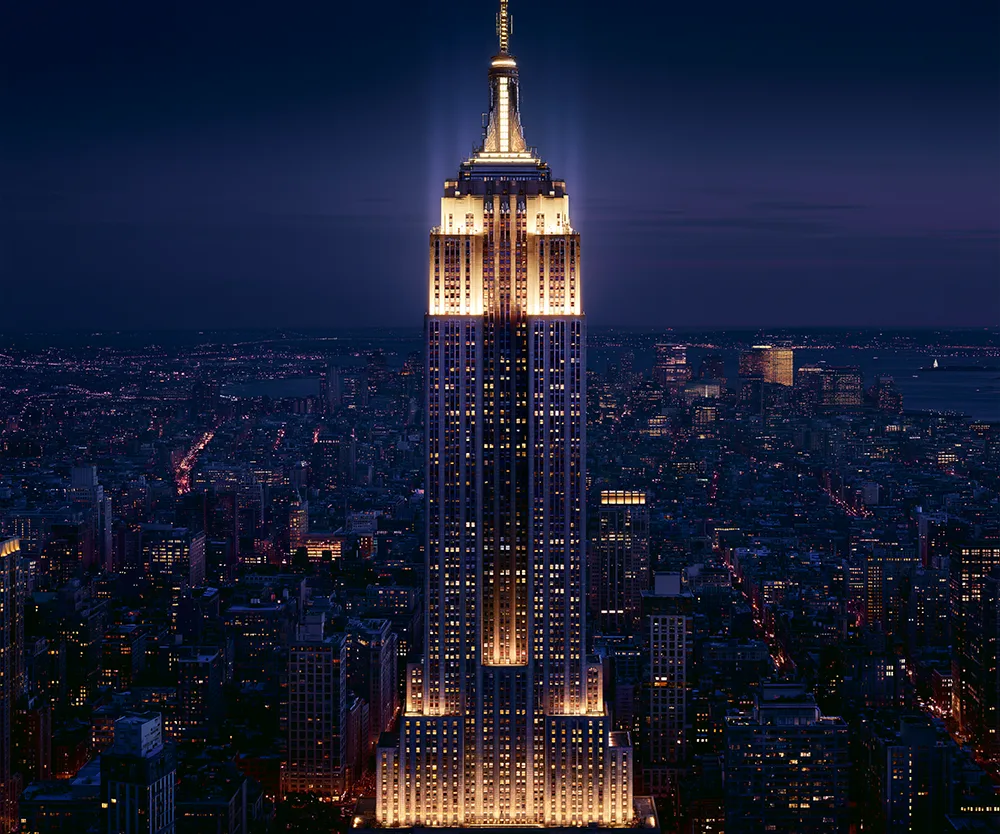
The Empire State Building’s crown was not lit until 1964 — the colored lights arrived in 1976.
A Legacy in Limestone and Steel
The building’s early years were famously hard. With the Depression strangling demand, so much of the tower sat empty that wags nicknamed it the “Empty State Building.” Yet it proved almost indestructible. On a foggy morning in July 1945, a B-25 bomber lost in the mist slammed into the 79th floor. Fourteen people died, but the building barely flinched — and one elevator operator, Betty Lou Oliver, survived a plunge of seventy-five stories, a record that still stands.
Pop culture did the rest. Just two years after it opened, a giant ape named Kong clung to its mast, and the Empire State Building became shorthand for New York itself. It held the title of world’s tallest building until the World Trade Center surpassed it nearly four decades later, was named a National Historic Landmark in 1986, and remains, for millions, the definitive American skyscraper.
Bring the Empire State Building Home
If its story and its silhouette speak to you, you can bring a piece of that Machine Age ambition into your own space. Browse the full Empire State Building wall art collection — from the vintage blueprint to the glowing nighttime skyline — or explore more New York and cityscape prints to build a gallery wall worthy of Manhattan itself.