
The History of the Chrysler Building: New York’s Art Deco Crown Jewel
For eleven short months, the Chrysler Building was the tallest structure human hands had ever raised. It lost the crown almost immediately — yet nearly a century later, it’s still the building New Yorkers point to first, and for many, the most beautiful skyscraper ever built. Its story is one of ambition, a bitter rivalry, and a spire raised in secret.
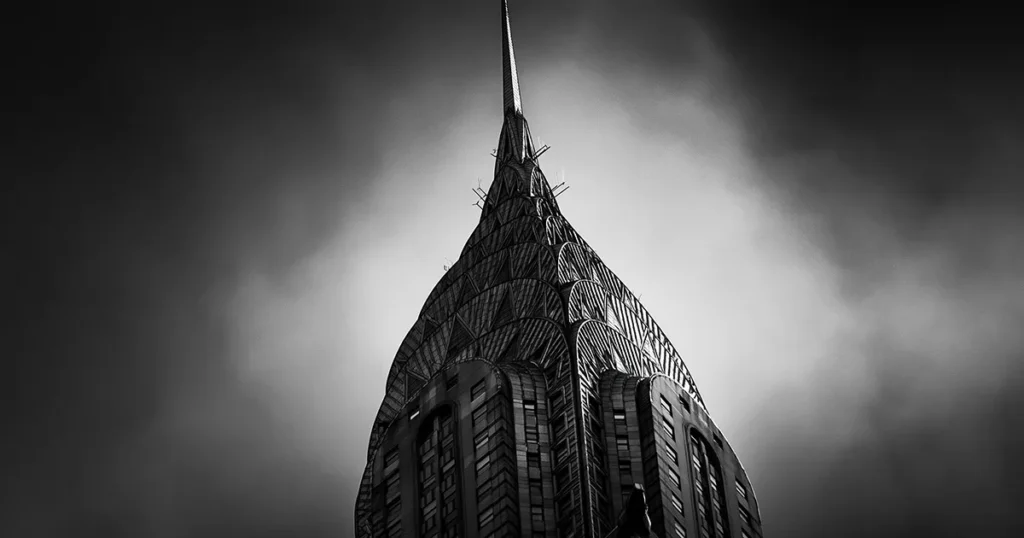
The Chrysler Building’s stainless-steel crown and spire.
A Monument to the Machine Age
The building wears the Chrysler name, but it was never owned by the Chrysler Corporation. Automobile magnate Walter P. Chrysler paid for it out of his own pocket — he wanted a monument his children could inherit, and a tribute to the industrial age that had made his fortune.
Chrysler took over the project in 1928 from developer William H. Reynolds, who held the original lease and had already hired architect William Van Alen. Van Alen was a visionary with a flair for the theatrical, and Chrysler handed him an irresistible brief: build the tallest building in the world — and make it sing the praises of the automobile.
The Secret Race to the Sky
Van Alen wasn’t the only architect chasing the clouds in 1929. Downtown, his former business partner turned bitter rival, H. Craig Severance, was racing to top out 40 Wall Street as the world’s tallest building. The two men kept quietly revising their plans upward, each determined to outbuild the other.
Severance thought he’d won at 927 feet. What he didn’t know was that Van Alen had a trick hidden inside the Chrysler Building’s crown: a 185-foot stainless steel spire, secretly assembled in pieces inside the building’s fire shaft. On October 23, 1929, in roughly ninety minutes, workers hoisted the spire up through the roof and bolted it into place.
In a single afternoon, the Chrysler Building shot to 1,046 feet — taller than 40 Wall Street, taller than the Eiffel Tower that had reigned for forty years, and the first building ever to break 1,000 feet. For that brief, glorious moment, it was the tallest thing on Earth.
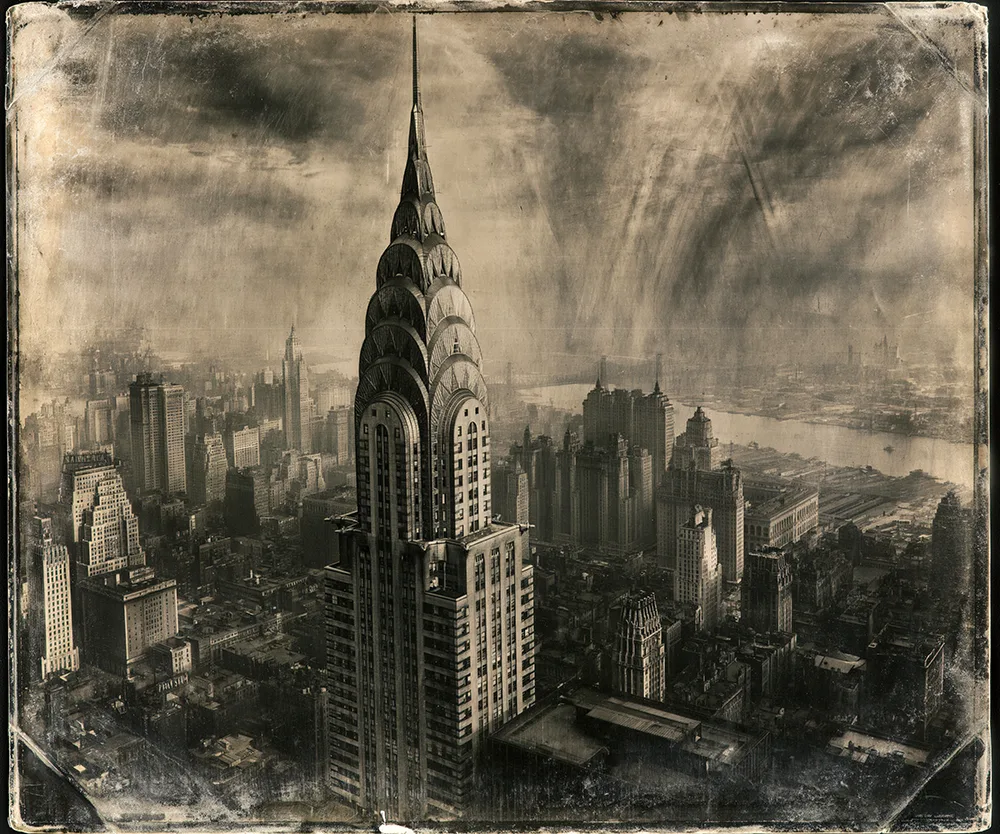
The Chrysler Building crowning the Manhattan skyline — for a brief eleven months, the tallest structure on Earth.
The triumph didn’t last. Just eleven months later the Empire State Building edged past it, and the Chrysler Building’s reign as world champion was over. But the title was never really the point. Its beauty was.
An Art Deco Masterpiece
Where other skyscrapers reached for height, the Chrysler Building reached for elegance. Van Alen clad the famous crown in Nirosta stainless steel, arranging it into seven radiating arches of triangular windows — a sunburst that still looks futuristic nearly a century on.
Look closer and the automobile is everywhere. At the 31st floor, winged ornaments modeled on 1929 Chrysler radiator caps and hubcaps crown the corners. Higher up, at the 61st floor, steel eagle gargoyles jut out over the street, their shapes lifted straight from Chrysler hood ornaments. The whole tower is a love letter to the machine, written in brick and steel.
If you’re drawn to that draftsman’s-eye view of the architecture, the Chrysler Building blueprint print captures exactly that spirit — the building rendered as a vintage technical drawing, drafting lines and all. And for the tower in its full Art Deco glory, the Art Deco Chrysler Building wall art celebrates those bold geometric lines and that unmistakable crown.
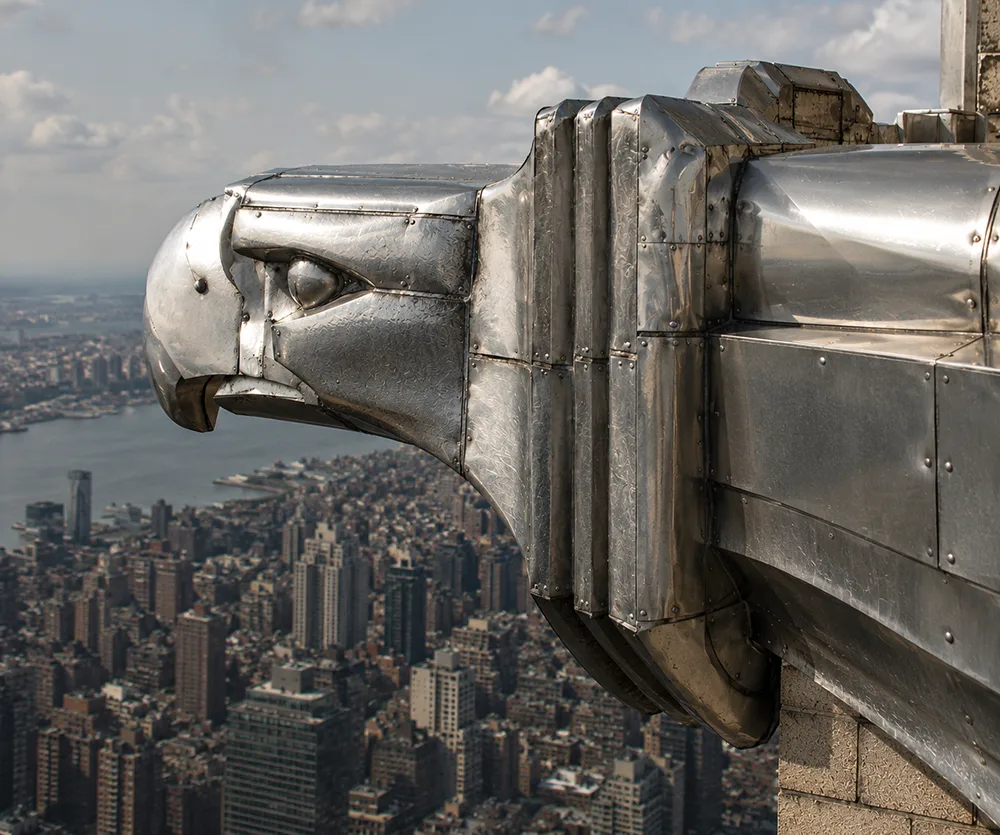
One of the Chrysler Building’s iconic 61st-floor eagle gargoyles, modeled after 1929 Chrysler hood ornaments.
Inside the Icon
The drama continues indoors. The lobby is a jewel box of red Moroccan marble, amber onyx, and inlaid-wood elevator doors, crowned by Edward Trumbull’s sweeping ceiling mural, Transport and Human Endeavor. Near the summit, the private Cloud Club once poured martinis for Manhattan’s elite across floors 66 to 68, and an observation deck on the 71st floor offered dizzying views until it closed in 1945.
The Chrysler Building After Dark
Here’s a surprise: the feature most people picture today — the crown lit up like a glowing fan against the night sky — wasn’t part of the original building at all. The triangular lighting that traces those steel arches wasn’t installed until 1981. Now, after sunset, the Chrysler Building transforms into something else entirely: a warm beacon glowing over the East Side.
That nighttime magic is the inspiration behind the Chrysler Building at night painting, which captures the crown ablaze against a deep, city-blue sky.
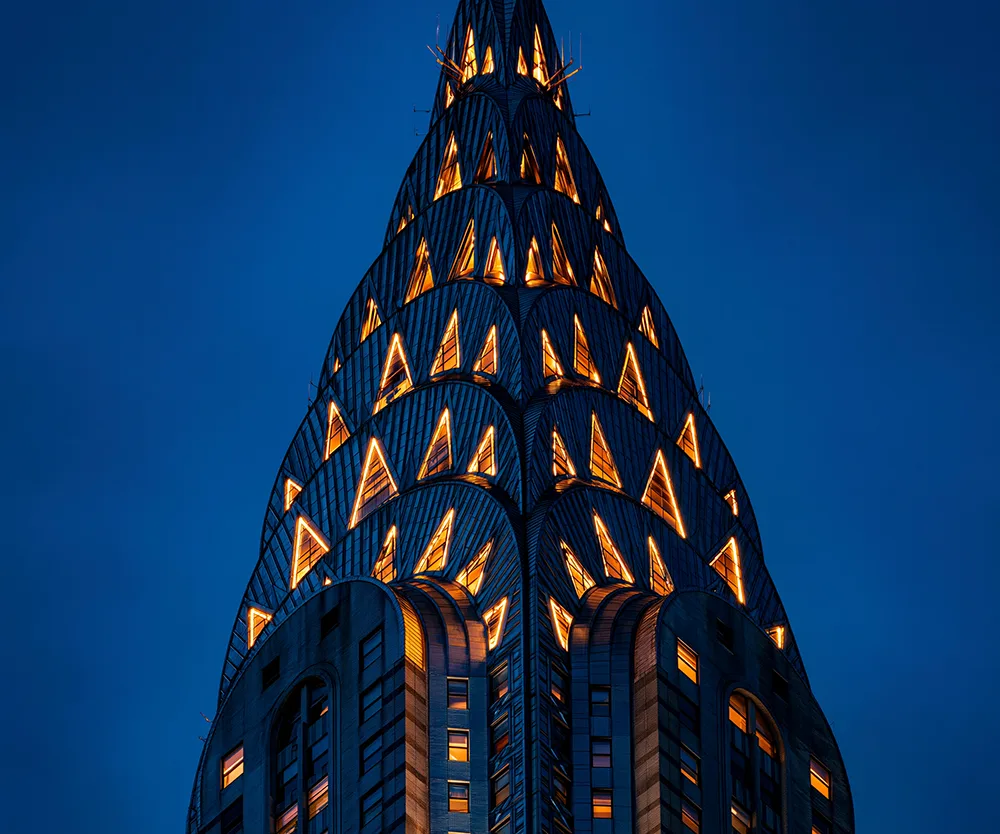
The Chrysler Building’s crown wasn’t lit until 1981 — now its triangular windows glow against the night sky.
A Legacy Cast in Steel
Van Alen’s masterpiece had a bittersweet ending for its creator. Walter Chrysler accused the architect of taking kickbacks from contractors and refused to pay his full fee. Van Alen had to sue to collect — and though he won, the scandal quietly ended his career. He designed the most beloved skyscraper in the world, then faded from view.
The building, though, has only grown more cherished. Named a National Historic Landmark in 1976, it endures as the definitive statement of Art Deco ambition — proof that a skyscraper can be more than tall. It can be art.
Bring the Chrysler Building Home
If its lines and history speak to you, you can bring a piece of that Art Deco magic into your own space. Browse the full Chrysler Building wall art collection — from the vintage blueprint to the glowing nighttime skyline — or explore more New York and cityscape prints to build a gallery wall worthy of Manhattan itself.